
By Natasha Glass, LPC | NGI Insights

When a client enters our therapeutic space, what exactly are we observing?
Are we observing dysfunction, or are we observing an adaptation to conditions we have yet to fully understand? Are we witnessing resistance, or are we encountering a protective response that once served a necessary purpose?
Perhaps a more uncomfortable question is this: how much of what we observe is influenced by the lens through which we have chosen to see?
As therapists, we are trained to recognize patterns, identify symptoms, conceptualize cases, and develop interventions. Yet, in our efforts to understand the individual, we can sometimes narrow our focus to the point that the conditions surrounding the individual become secondary.
What happens when we widen that lens?
It is through this line of questioning that I began developing the Contextual Recursive Framework (CRF).
What Are We Actually Seeing?
When we encounter a client's emotional or behavioral response, we are often encountering the expression of something much larger than what is immediately visible.
Consider a client who struggles to trust others. We may conceptualize their experience through attachment, trauma, avoidance, or interpersonal difficulties. These perspectives may offer valuable clinical information, but have we sufficiently explored the conditions under which distrust became necessary?
More importantly, have we considered whether those conditions still exist?
There is a meaningful difference between helping someone recognize that a previously protective response is no longer necessary and asking someone to relinquish a protective response while they remain within the conditions that require it.
When we overlook this distinction, we risk interpreting survival as dysfunction.
We may begin treating the individual's response without adequately understanding what the individual is responding to.
The Individual Does Not Exist in Isolation
Human experiences are shaped within interconnected systems. Our relationships, cultural identities, historical experiences, physiological responses, social environments, and access to resources all contribute to how we experience and navigate the world.
Yet, when someone enters therapy, much of the responsibility for change is placed upon the individual.
We encourage emotional regulation, cognitive restructuring, healthier boundaries, and behavioral change. These interventions can be valuable. However, we must also consider the conditions within which we are asking the client to change.
What does emotional regulation mean for someone who remains in an unpredictable environment?
What does establishing boundaries mean for someone whose safety or financial stability depends upon the relationship in which those boundaries are needed?
What does challenging a client's perception mean when that perception has been informed by repeated experiences of discrimination, rejection, or oppression?
Kimberlé Crenshaw's (1989) work on intersectionality challenges us to consider how overlapping systems of power and oppression shape experiences that cannot be adequately understood through a single dimension of identity. This consideration is particularly relevant when we examine how clients experience the world and how their experiences are interpreted within clinical settings.
These questions do not diminish the importance of individual agency. They invite us to consider the conditions within which agency can be exercised.
Understanding the individual requires more than understanding what exists within the individual.
Introducing the Contextual Recursive Framework
The Contextual Recursive Framework (CRF) is a developing integrative, metatheoretical clinical conceptualization and reasoning framework that invites helping professionals to expand their understanding of human experience through three interconnected processes: Resonance, Contextualization, and Conscious Participation.
Drawing upon established theoretical traditions, including general systems theory (von Bertalanffy, 1968), second-order cybernetics (Scott, 2004), person-centered theory (Rogers, 1957), and intersectionality (Crenshaw, 1989), CRF recognizes that emotional experiences and behavioral responses emerge within dynamic, interconnected conditions.
The Contextual Recursive Framework is not intended to replace established therapeutic theories or prescribe a particular modality. Rather, it seeks to expand the clinical thinking that informs their application.
Regardless of theoretical orientation, therapists must make decisions about what they observe, how they interpret an experience, and how they respond. CRF invites us to become more conscious of the processes through which those decisions are made, supporting a more intentional, contextually informed application of our chosen therapeutic approaches.
The framework is not intended to prescribe what therapists should think, but to expand how therapists think.
At its foundation is a guiding principle:
See the whole before interpreting the parts.
Resonance
Resonance invites us to explore the emotional experience and what may be emotionally carried forward across time, relationships, and environments.
Within this process exists the concept of the Emotional Echo, which I introduced in an earlier NGI Insight, When Past Emotions Surface in the Present: Understanding the Emotional Echo.
An emotion experienced in the present may carry elements of an earlier emotional experience. However, recognizing the influence of the past does not require us to dismiss the reality of the present.
A client can experience historically influenced emotional activation while also responding to a genuinely harmful present-day circumstance.
Both can be true.
Our responsibility is not to determine prematurely which experience is more legitimate but to create space for a fuller understanding of what is being emotionally experienced.
Contextualization
Contextualization invites us to expand our inquiry beyond the emotional or behavioral response itself.
Within what conditions was this emotion created or produced?
What historical, relational, cultural, physiological, and systemic influences contributed to its development? What conditions continue to sustain it?
Rather than immediately asking what needs to change within the individual, we begin to consider what may need to change within the conditions surrounding the individual.
This may require us to examine circumstances that extend beyond the therapeutic space, including access to resources, relational safety, economic stability, institutional practices, and experiences of oppression.
Contextual understanding does not eliminate personal responsibility. It allows us to consider responsibility within a more complete understanding of the individual's circumstances.
Conscious Participation
Conscious Participation invites both the client and the therapist to examine how they participate within the systems they inhabit.
As awareness expands, opportunities for more intentional participation may emerge. However, awareness alone does not remove systemic barriers, create safety, or provide access to resources.
Conscious Participation requires an understanding of both possibility and limitation.
For the client, this may involve recognizing established patterns, understanding their protective functions, identifying available choices, and developing new ways of engaging with their environment.
For the therapist, it requires an examination of how our own participation influences the therapeutic process.
Why Recursive?
Resonance, Contextualization, and Conscious Participation are not linear stages through which the client or therapist must progress.
They are interconnected processes that continuously inform one another.
As new emotional experiences become visible, our understanding of their context may change. As individuals participate differently within their relationships and environments, new emotional experiences may emerge. As therapists reconsider our interpretations, the therapeutic relationship itself may shift.
Each process creates opportunities to revisit and deepen our understanding of the others.
This recursive process also extends to our clinical decisions. The interventions we introduce into the therapeutic relationship generate new experiences and information that may require us to reconsider our initial understanding, our chosen approach, or the conditions influencing the client's response.
Understanding is not a destination at which we permanently arrive. It remains open to revision.
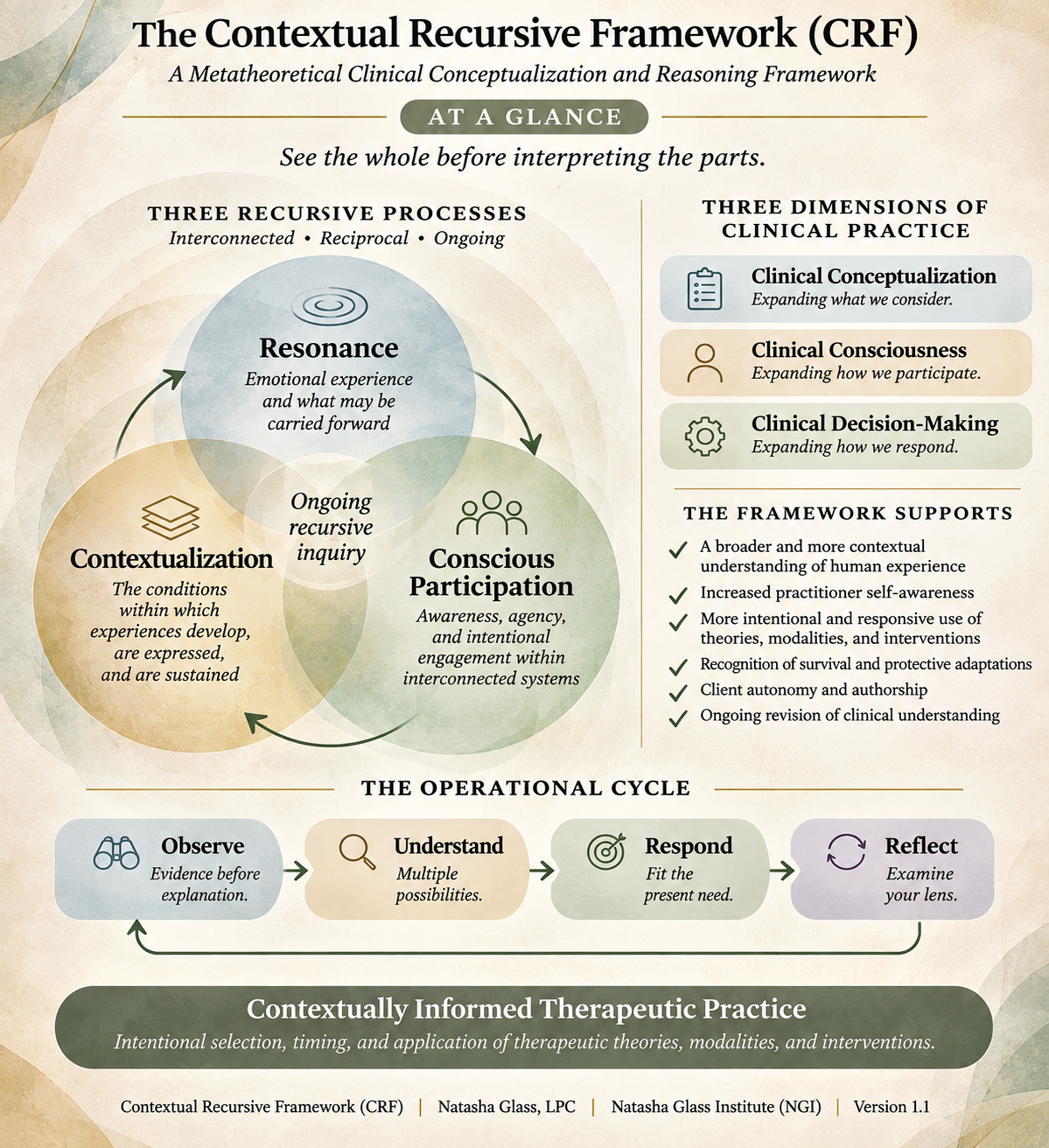
The Contextual Recursive Framework (CRF) at a Glance. Developed by Natasha Glass, LPC, Natasha Glass Institute. Version 1.1, November 2026.
The Therapist Is Not Outside the System
One of the more challenging considerations within CRF is the recognition that we are not simply observing the therapeutic system. We are participating in it.
This perspective draws upon second-order cybernetics, which incorporates the observer into the understanding of the system being observed (Scott, 2004).
Our theoretical orientations, personal experiences, cultural identities, assumptions, emotional responses, and professional authority influence how we understand our clients.
They also influence how our clients experience us.
When we identify a client as resistant, have we considered whether something within our approach is contributing to their reluctance?
When we perceive a client as lacking insight, have we considered whether they are offering an understanding of their experience that differs from our own?
When a client disagrees with our interpretation, can we remain curious about that disagreement without immediately interpreting it through the very framework they are questioning?
These considerations do not require us to abandon our clinical expertise. Nor do they suggest that we should avoid challenging clients, identifying incongruence, or addressing harmful patterns.
They require us to remain conscious of how we exercise that expertise.
We must also be willing to recognize when our need for certainty, our attachment to a particular interpretation, or our investment in being perceived as the expert begins to influence the therapeutic relationship.
We are professionals within the therapeutic relationship, but we are not the authors of another person's lived experience.
Expanding the Thinking Behind Therapeutic Practice
As therapists, we invest considerable time in developing our theoretical knowledge and clinical competence. We learn how to conceptualize human experiences, apply therapeutic techniques, and facilitate change.
But how often do we examine the thinking that guides our application of that knowledge?
Knowing a therapeutic modality does not necessarily establish when, why, or under what conditions its application is appropriate.
An intervention may be theoretically appropriate without being contextually appropriate at a particular moment.
Consider a therapist who recognizes an opportunity for cognitive restructuring. Before challenging the client's belief, have we sufficiently explored whether that belief reflects an ongoing environmental reality?
Consider a therapist preparing to engage a client in trauma processing. Have we considered the client's present circumstances, available resources, safety, and emotional readiness?
These considerations are not necessarily absent from established therapeutic approaches. CRF invites us to examine them intentionally, regardless of the theoretical orientation through which we practice.
Through its three recursive processes, the framework seeks to support three interconnected dimensions of clinical practice:
Clinical Conceptualization: Expanding what we consider when developing an understanding of the client's experience.
Clinical Consciousness: Expanding our awareness of the assumptions, interpretations, and relational influences that shape our participation.
Clinical Decision-Making: Expanding the intentionality with which we select, time, and apply our professional knowledge.
These dimensions invite us to consider not only whether we know how to implement an intervention but also whether we understand the conditions within which we are implementing it.
CRF is concerned not only with what the therapist does, but with the consciousness from which the therapist does it.
Before You Label, See the Whole
The Contextual Recursive Framework does not reject diagnosis, clinical interpretation, or established therapeutic modalities. Instead, it invites us to consider the breadth of our understanding before determining how to apply them.
A diagnosis may describe an individual's experience without fully explaining the conditions that contributed to its development.
We cannot assume that because we have identified a pattern, we have understood its origin.
We cannot assume that because we recognize a symptom, we understand the conditions that sustain it.
And we cannot assume that because we possess clinical knowledge, we are immune to the limitations of our own perspectives.
Seeing the whole does not mean that we can attain complete knowledge of another person's experience. It means remaining willing to expand our understanding and recognize what may exist beyond our current field of observation.
Perhaps one of the most meaningful responsibilities we hold as therapists is remaining willing to reconsider what we believe we already understand.
As I continue developing and exploring the Contextual Recursive Framework through future NGI Insights, I invite you to consider a question within your own clinical practice:
What becomes visible when you expand your understanding beyond the individual and begin examining the conditions within which their experience exists, including your own participation in those conditions?
Before you label, see the whole picture first.
References
Crenshaw, K. (1989). Demarginalizing the intersection of race and sex: A Black feminist critique of antidiscrimination doctrine, feminist theory and antiracist politics. University of Chicago Legal Forum, 1989(1), 139–167. https://chicagounbound.uchicago.edu/uclf/vol1989/iss1/8/
Rogers, C. R. (1957). The necessary and sufficient conditions of therapeutic personality change. Journal of Consulting Psychology, 21(2), 95–103. https://doi.org/10.1037/h0045357
Scott, B. (2004). Second-order cybernetics: An historical introduction. Kybernetes, 33(9/10), 1365–1378. https://doi.org/10.1108/03684920410556007
von Bertalanffy, L. (1968). General system theory: Foundations, development, applications. George Braziller.
About the Contextual Recursive Framework
The Contextual Recursive Framework (CRF), including its integration of Resonance, Contextualization, and Conscious Participation, is being developed by Natasha Glass, LPC, founder of Natasha Glass Institute.
CRF draws upon established theoretical and scholarly traditions while proposing an integrative, metatheoretical framework for clinical conceptualization, practitioner consciousness, and contextually informed clinical decision-making.
It is presented as a developing clinical framework rather than an independently validated treatment modality.
Natasha Glass Institute
Opening consciousness. Transforming care.
© 2026 Natasha Glass Institute. All rights reserved.